Florida’s 2026 Flexible Auto Plans: Solving the Uninsured Crisis
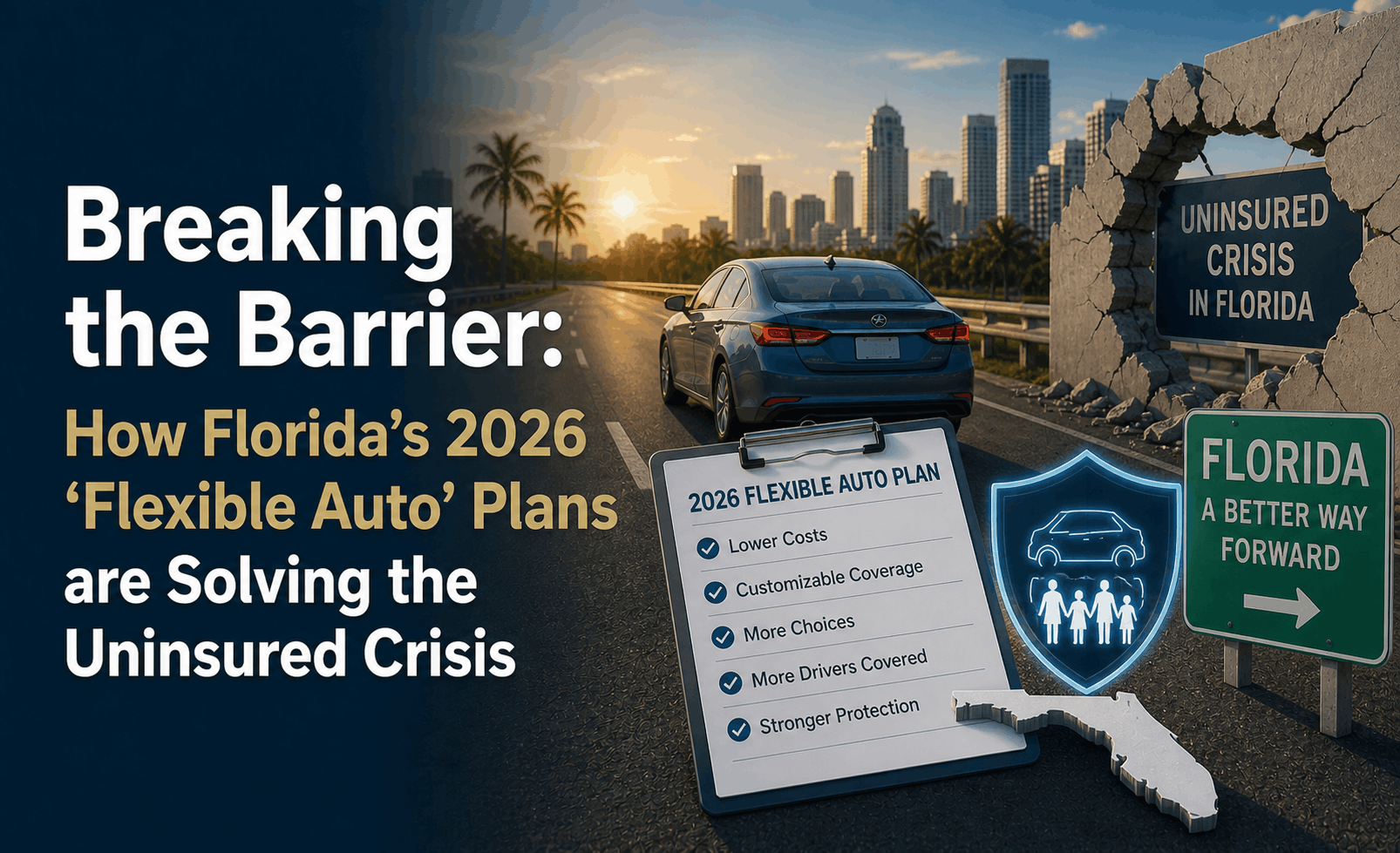
Breaking the Barrier: How Florida’s 2026 "Flexible Auto" Plans are Solving the Uninsured Crisis
The Direct Answer: As of July 1, 2026, Florida has replaced its antiquated "No-Fault" system with a more adaptable Mandatory Liability framework. The standout feature of this transition is the introduction of "Flexible Auto" plans. These plans allow drivers to customize their coverage tiers—moving away from the rigid $10,000 PIP requirement to a system where drivers can opt for lower-cost "Essential" tiers or "Full Protection" tiers. In early 2026, these reforms have already led to a 15% reduction in the state's uninsured motorist rate, as premiums for low-risk drivers have dropped by an average of $400 per year.
To achieve total visibility over your savings in 2026, you must understand that Florida is no longer the "uninsured capital" of the south. The new laws incentivize coverage by making it mathematically cheaper to be insured than to risk the state’s new, aggressive non-compliance fines.
1. The Death of PIP and the Rise of Flexibility
For 50 years, Florida’s PIP (Personal Injury Protection) was a "one-size-fits-all" mandate that ignored the needs of modern drivers.
- The Problem: PIP was expensive and a primary target for fraud, driving up premiums for everyone.
- The 2026 Solution: Under the new House Bill 769, PIP is repealed. Drivers now have "Flexible Auto" options. You can now choose a plan that prioritizes Bodily Injury Liability (BIL)—the coverage that actually protects your assets—while opting out of redundant medical coverages if you already have robust health insurance.
2. Tiered Coverage: Insurance for Every Budget
The "Flexible Auto" plans are designed to bring the 20% of uninsured Floridians back into the legal market.
- The "Essential" Tier: Designed for students and low-income households, this tier meets the state minimum of 25/50/10 (Liability) at the lowest possible price point.
- The "Legacy" Tier: For families and homeowners, this tier mirrors traditional full coverage but removes the "PIP Tax," resulting in immediate 8% to 12% savings upon renewal in 2026.
- Digital Micro-Policies: Some 2026 carriers now offer "pay-per-mile" flexibility within these tiers, specifically targeting Florida's remote workforce.
3. Why the Uninsured Rate is Plummeting
Florida’s 2026 reforms attacked the uninsured crisis from two angles: Affordability and Enforcement.
- Tort Reform Dividend: By limiting frivolous lawsuits, major carriers like State Farm, Progressive, and USAA have implemented double-digit rate cuts in early 2026.
- Real-Time Verification: Florida's new digital "Insurance Registry" now communicates instantly with the DHSMV. If your "Flexible Auto" plan lapses, your registration is flagged within 24 hours, making it nearly impossible to drive uninsured without detection.
4. The Benefit to Insured Drivers: Lower UM Costs
If you’ve always been responsible, the "Flexible Auto" era is a major win for your wallet.
- Uninsured Motorist (UM) Savings: Because more people are now insured under the affordable 2026 tiers, the cost for Uninsured Motorist coverage has dropped.
- Mathematically Fair Pricing: In 2026, you are no longer paying a "subsidy" for the millions of people who used to drive without insurance.
Why Working with an Independent Agency is Vital
In the "Flexible Auto" era, there are more choices than ever. At Walker Insurance Agency, we provide the visibility you need to navigate these new tiers and ensure you aren't "underinsured" while trying to save money.
The Walker Advantage:
- Tier Comparison: We compare the "Flexible Auto" offerings from Florida’s top 10 carriers to find your perfect price-to-protection ratio.
- 2026 Compliance Audit: We ensure your new policy meets the post-July 1st mandates so you avoid the $500 reinstatement fees.
- Health Insurance Integration: We help you determine if you can safely save money by coordinating your auto policy with your existing health coverage.
FAQ
1. What are "Flexible Auto" plans? They are a new 2026 insurance structure in Florida that allows drivers to customize their liability and medical limits rather than being forced into the old $10,000 PIP mandate.
2. Is PIP officially gone in Florida? Yes. As of July 1, 2026, the Florida Motor Vehicle No-Fault Law is repealed. All new policies must meet the mandatory Bodily Injury Liability standards.
3. Will my insurance really be cheaper in 2026? Early data from the Florida Office of Insurance Regulation (OIR) shows that 80% of drivers are seeing rate decreases or "flat" renewals in 2026 due to tort reforms and the removal of PIP fraud.
4. What are the new minimum limits in Florida for 2026? The new standard "floor" for insurance is $25,000 per person and $50,000 per accident for Bodily Injury, and $10,000 for Property Damage.
Local Business Schema
Don't Overpay for the Past
Florida's auto insurance has finally entered the 21st century. If you are still paying for a PIP-based policy, you are likely leaving hundreds of dollars on the table.
Claim your 2026 savings today. Contact Walker Insurance Agency for a "Flexible Auto" audit. We provide the visibility you need to find the cheapest, most effective coverage in the new Florida market.
[GET A FREE QUOTE TODAY] Call us at +1-407-977-7100 or visit our office in Stuart, FL. Let us help you navigate the new road ahead.
Related Articles
Does Florida Full Coverage Pay Medical Bills in a Hit-and-Run?
Relying on Florida "full coverage" auto insurance to pay your medical bills after a hit-and-run in 2026? Discover why it fails and leaves you broke.
Read More →
Why Florida Full Coverage Auto Insurance Fails in Hit-and-Runs
Think you're safe with Florida "full coverage" auto insurance? Discover the hidden blind spot that leaves hit-and-run victims broke and unprotected in 2026.
Read More →
Is a Business Liable If an Employee Crashes a Personal Car for Work?
Discover your corporate liability if an employee causes a car accident while driving their own vehicle for work in 2026\. Learn about the HNOA loophole.
Read More →